Watch the heaviest sets in any gym and you will see lifters fastening a belt before they squat or pull. A weightlifting belt (Gewichthebergürtel in German) is not a badge of honour, it is a tool that helps you brace your trunk under heavy load. Used at the right time, it makes heavy lifting feel more stable.
What a lifting belt does
A belt does not hold your spine in place by itself. It gives your core something to push against. When you take a big breath into your belly and brace against the belt, you build pressure inside your trunk (intra-abdominal pressure), which makes your torso stiffer and more stable under the bar.
- More stability in heavy squats, deadlifts and presses.
- Better bracing awareness, because the belt gives you clear feedback when you brace correctly.
- Confidence under load on top sets and attempts.
Important: a belt does not replace good technique or a strong core, and it is not a treatment for back pain. If your back hurts, get it checked by a physiotherapist before you load it.
When to wear a belt
- Heavy compound lifts: squats, deadlifts, front squats and overhead presses, roughly from 80 percent of your one-rep max upwards.
- Max attempts and PRs, where every bit of stability counts.
- Heavy volume: high-rep sets with substantial loads, when your trunk starts to fatigue.
When to leave it off
- Warm-up and light sets. Learn to brace without a belt first.
- Most gymnastics and conditioning work. Pull-ups, box jumps or rowing do not need a belt.
- Fast, light barbell cycling in WODs, unless the weight is genuinely heavy for you.
How to brace with a belt
- Put the belt on around your waist, roughly at belly-button height. It should cover the area between your lower ribs and your hips.
- Tighten it so you can still slide a flat hand between belt and belly when you breathe out.
- Before each rep, take a big breath into your belly, not your chest.
- Push your belly and sides out against the belt and hold that pressure through the lift.
- Breathe out at the top, then reset your breath before the next rep.
Loosen the belt between sets. Wearing it tight all the time makes breathing harder and adds nothing.
Squat belt, deadlift belt or one belt for everything?
Most athletes do fine with one belt for both. Some lifters find a slightly narrower or more flexible belt more comfortable for deadlifts and Olympic lifts, because it does not dig into the hips at the bottom position. A wider, firmer belt is popular for heavy squats.
Types of lifting belt
| Type | Pros | Best for | At Gear 9 |
|---|---|---|---|
| Nylon belt with Velcro | Light, flexible, quick on and off | CrossFit, weightlifting, mixed training | Velites Lifting Belt (CHF 29), Gear 9 Nylon Belt (CHF 29), Picsil Weight Lifting Belt (CHF 19) |
| Higher-end nylon belts | Same flexible type, higher-end models | Regular heavy squats and deadlifts | Picsil LockPro (CHF 45), Picsil 2nd Gen (CHF 45), Rehband X-RX Lifting Belt (CHF 39) |
| Neoprene back support | Warmth and light support | General training, comfort for the lower back | Rehband X-RX 2-in-1 Back Support 7mm (CHF 89) |
| Leather or lever belt | Very stiff, maximum support | Powerlifting and maximal strength | Not in our range |
For CrossFit and functional training we recommend a nylon belt: it moves with you, closes in a second and works for squats, cleans and deadlifts alike.
How to find the right size
Measure around your waist at belly-button height, not your trouser size, and compare with the size chart on the product page. The belt should close comfortably in the middle of its adjustment range so you can tighten or loosen it as needed.
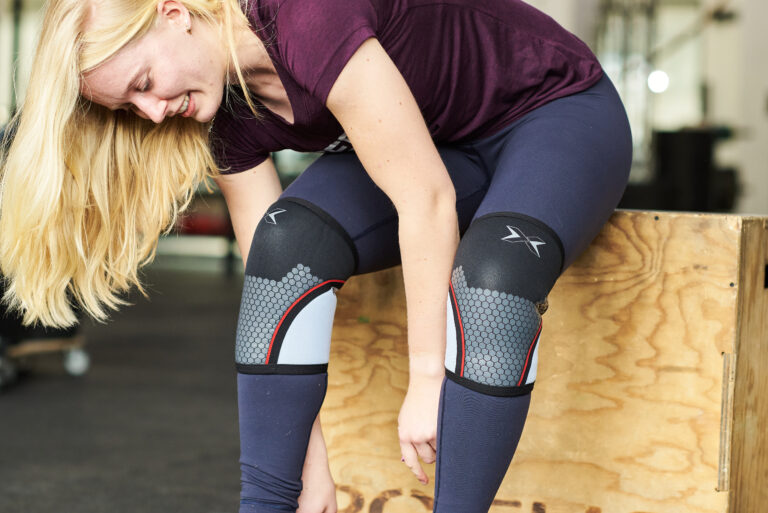
Lifting heavy? Combine your belt with knee sleeves for squats, wrist wraps for presses and lifting straps for heavy pulls.
Frequently asked questions
When should I start using a weightlifting belt?
Once you can brace properly without a belt and are lifting heavy, roughly from 80 percent of your one-rep max upwards in squats, deadlifts and presses.
Does a lifting belt weaken your core?
Not when used selectively. Do warm-ups and lighter sets without a belt and use it for heavy sets, so your core still has to work on its own.
How tight should a lifting belt be?
Tight enough that you can brace against it, but loose enough to take a full breath into your belly. A flat hand should just fit between belt and belly when you breathe out.
Is a nylon belt good enough for heavy squats?
For most athletes, yes. Nylon belts give solid support and are more versatile for CrossFit and weightlifting. Very heavy powerlifting often uses stiffer leather or lever belts.
Where can I buy a weightlifting belt (Gewichthebergürtel) in Switzerland?
Gear 9 stocks lifting belts from Picsil, Velites, Rehband and Gear 9 and ships from Zurich with Swiss Post. Delivery is free from CHF 70.